
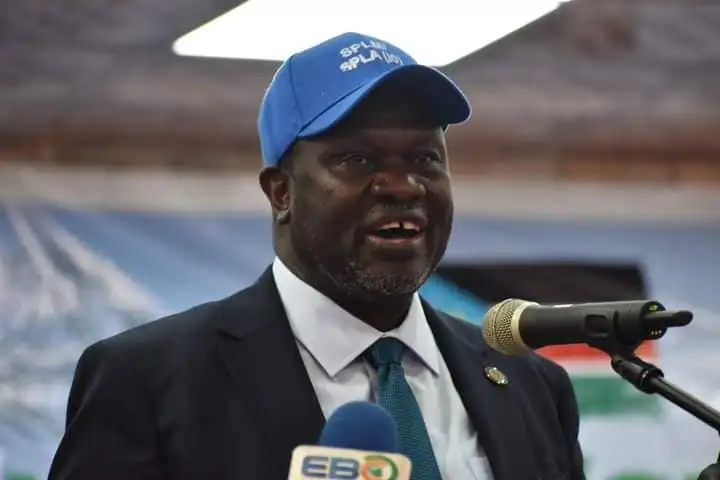
STAFF – A South Sudanese lawmaker has warned that proposed amendments to the National Elections Act could pave the way for the removal of First Vice President Riek Machar and other vice presidents ahead of the planned December elections, while allowing President Salva Kiir to retain full executive powers throughout the electoral period.
Hon. Makuach Teny, a member of the Transitional National Legislative Assembly affiliated with the SPLM-IO faction led by interim chairperson Stephen Par Kuol, said the National Elections Act, 2012 (Amendment) Bill, 2026 would significantly change the structure of the transitional government during the election period.
The bill, presented to Parliament by Justice and Constitutional Affairs Minister Dr. Wek Mamer Kuol, provides that the incumbent President would remain in office with his constitutional powers throughout the election period. It also proposes that the First Vice President and other vice presidents be removed from their positions three months before polling day.
The provision would affect Machar, who is currently the First Vice President and is facing trial before a special court in Juba.
Hon. Makuach while speaking during funeral in Juba said the proposed arrangement would allow South Sudan to operate with what he described as a partial government during the election period until a new government is elected.
The proposed amendments would also provide for a 332-member elected National Legislative Assembly, with seats allocated through geographical constituencies, women’s representation and party lists.
Makuach defended the planned elections, saying voting remains the way forward for South Sudan.
However, Hon. Kuong Dak, a prominent SPLM-IO figure aligned with Machar and a former national lawmaker, questioned whether elections can be conducted without first establishing a peaceful political and security environment.
Dak, who served as an elected MP during Sudan’s 2010 general elections, said peace should be prioritized to ensure that elections do not contribute to renewed conflict.
He argued that the electoral process should take place in an environment where political parties and candidates can participate freely and peacefully.
The debate over the proposed amendments comes amid continuing disagreements over implementation of the 2018 Revitalized Peace Agreement and the conditions for holding elections.
The South Sudan Opposition Alliance (SSOA) said on Monday that recent amendments to the peace agreement, the Transitional Constitution and electoral law were undertaken without the consultation and dialogue among signatories that had been agreed upon.
The Transitional National Legislative Assembly was expected to debate the Elections Act amendments on Monday, but postponed the sitting from 10 a.m. to 2 p.m. No official reason was immediately given for the delay.
The bill was referred to the Parliament’s Committee on Legislation and Justice after its first reading last week.
Parliamentary spokesperson Oliver Mori said the proposed legislation contains two chapters and 17 sections covering, among other issues, the executive and the composition of Parliament during and after the elections.
South Sudan is scheduled to hold general elections on December 22, 2026, after repeated extensions of the transitional period established under the 2018 peace agreement.