
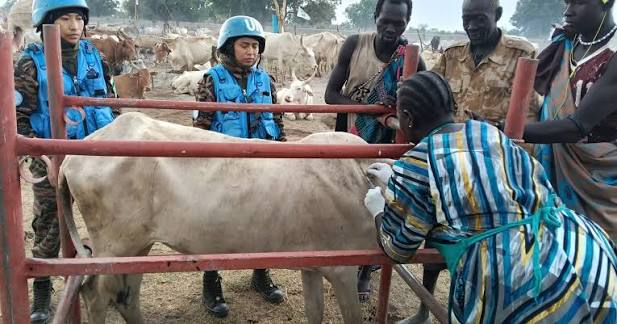
The Minister of Livestock and Fisheries, Onyoti Adigo Nyikwec, has outlined South Sudan’s long-term plan to transform the livestock sector, calling for sustained investment in rangeland management, animal health, market infrastructure, and pastoral livelihoods to unlock the country’s economic potential.
Speaking at the opening of a two-day National Policy Dialogue to commemorate the International Year of Rangelands and Pastoralists (IYRP 2026) in Juba on Tuesday, Minister Onyoti described the dialogue as a critical step towards developing a modern, resilient, and competitive livestock industry.
He said South Sudan is endowed with one of Africa’s largest livestock resources, with more than 60 percent of its land consisting of rangelands that support an estimated 12 million cattle, 14 million goats, and 13 million sheep.
“These resources sustain millions of citizens, provide food and income, preserve our pastoral cultural heritage, and represent one of our greatest opportunities for inclusive economic growth,” Onyoti said.
Despite this vast potential, the minister acknowledged that the sector continues to face significant challenges, including climate change, land degradation, livestock diseases, weak veterinary services, inadequate infrastructure, limited market access, and conflicts over natural resources.
He noted that competition over grazing land and water has contributed to recurring violence between cattle keepers and farming communities, underscoring the need for practical and lasting solutions.
“We need to look into these issues seriously and amicably so that we can find lasting solutions,” he said, emphasizing the importance of establishing livestock migration corridors to reduce conflicts between pastoralists and farmers.
To address these challenges, Onyoti said the government has developed a long-term strategy focused on strengthening livestock production and improving pastoral livelihoods.
The plan prioritizes sustainable rangeland governance and the protection of livestock migration routes, restoration of degraded grazing lands through climate-smart approaches, modernization of veterinary services and disease surveillance systems, promotion of peaceful management of natural resources, expansion of livestock value chains and regional trade, and increased investment in women, youth, research, innovation, and skills development.
He revealed that, with support from the World Bank, the government is implementing the Livestock Sector Resilience Project, which aims to improve animal health services and strengthen rangeland management. A National Natural Resources Strategy has also been developed and is awaiting validation.
The minister stressed that humanitarian assistance alone cannot transform the livestock sector and urged development partners, financial institutions, private investors, researchers, civil society organizations, and pastoral communities to support long-term investments.
“The time has come to shift from short-term response to long-term investment. Every investment in rangeland restoration, animal health, market infrastructure, climate resilience, and pastoral livelihoods generates multiple returns, including increased productivity, improved food security, stronger rural economies, reduced conflict, and greater national stability,” Onyoti said.
The National Policy Dialogue brought together government officials, development partners, researchers, civil society organizations, and pastoralist representatives to discuss policies that will strengthen South Sudan’s livestock sector and promote sustainable management of the country’s rangelands.