
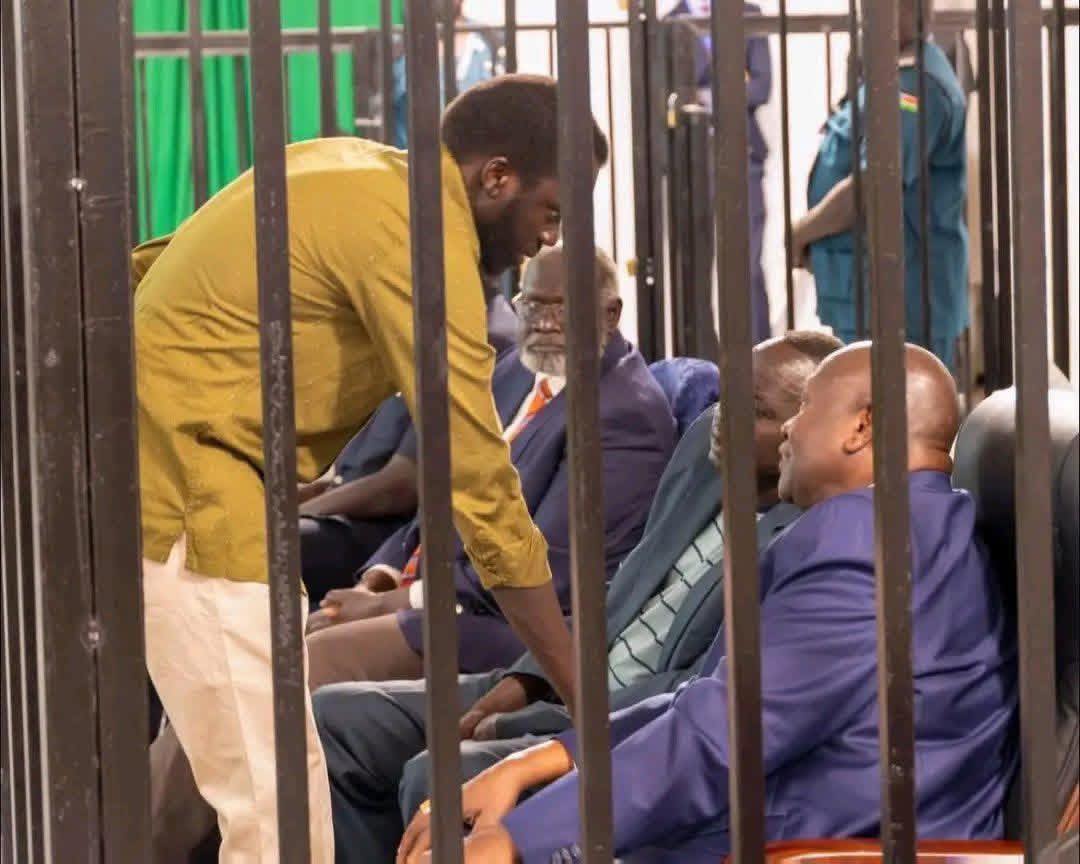
Proceedings in the high-profile Nasir case resumed today at Freedom Hall in Juba, where South Sudan’s Minister of Petroleum, Hon. Puot Kang Chol, delivered a detailed statement before the Special Court during its 74th session.
The minister, who is among senior SPLM/A-IO officials standing trial alongside First Vice President Dr. Riek Machar, used his testimony to outline his account of events surrounding the March 2025 Nasir incident and to challenge the legality of his arrest and detention.
The Nasir case stems from a series of violent confrontations between local armed youth groups commonly referred to as the White Army and the South Sudan People’s Defence Forces (SSPDF) in Nasir and Ulang counties of Upper Nile State. According to court records and testimonies, tensions had been building since August 2020, with at least 20 reported clashes prior to the major escalation on March 3–4, 2025.
The March incident, now central to the court proceedings, involved heavy fighting that resulted in casualties, displacement, and heightened political tensions within the unity government. Authorities subsequently launched investigations, leading to the arrest of several SPLM/A-IO figures accused of involvement or incitement.
In his submission, Hon. Puot Kang denied wrongdoing and described his role as one aimed at de-escalation rather than incitement.
He told the court that prior to the March violence, efforts had been underway through the Joint Defence Board (JDB) to deploy Necessary Unified Forces (NUF) to Nasir to stabilize relations between civilians and government troops.
He further explained that political leaders, including Dr. Riek Machar, had initiated dialogue with local authorities, chiefs, and youth leaders to reduce tensions in the Sobat corridor. According to his account, agreements were reached to allow humanitarian access and disperse armed youth prior to the outbreak of violence.
The minister also detailed the circumstances of his arrest on the night of March 4, 2025, alleging that National Security Service (NSS) officers detained him without a warrant and without formal lifting of his ministerial immunity.
He claimed that multiple individuals at his residence including relatives and visitors were arrested alongside him.
He further alleged mistreatment during detention, including prolonged confinement under harsh conditions, and raised concerns over the seizure of personal property following his arrest.
A central issue raised during the hearing was the legality of the investigative process. Puot Kang questioned the formation of the committee probing the Nasir incident, arguing that the clashes fell under ceasefire monitoring mechanisms rather than domestic criminal jurisdiction. He also challenged the inclusion of military personnel in the investigative body despite being a civilian official.
The defense maintains that the case is politically motivated, while prosecutors argue that the state has the authority to investigate and prosecute violations occurring within its territory.
The Nasir trial has drawn national and international attention, as it intersects with the fragile implementation of South Sudan’s Revitalized Peace Agreement.
Analysts note that tensions in Upper Nile State reflect broader challenges, including incomplete security arrangements, delayed deployment of unified forces, and local grievances over military presence.
Ceasefire monitoring bodies such as CTSAMVM have previously investigated earlier clashes in the region, though the March 2025 incident is being handled through the current court process.
Presiding Judge James Alala Deng adjourned the session until May 8, 2026, when Hon. Puot Kang is expected to continue his testimony.
Meanwhile, the SPLM/A-IO leadership has rejected the legitimacy of the Special Court, calling for the release of detained officials and warning that the proceedings could undermine the peace agreement.
The case continues to be closely watched as a test of both judicial independence and the durability of South Sudan’s transitional political arrangements.