
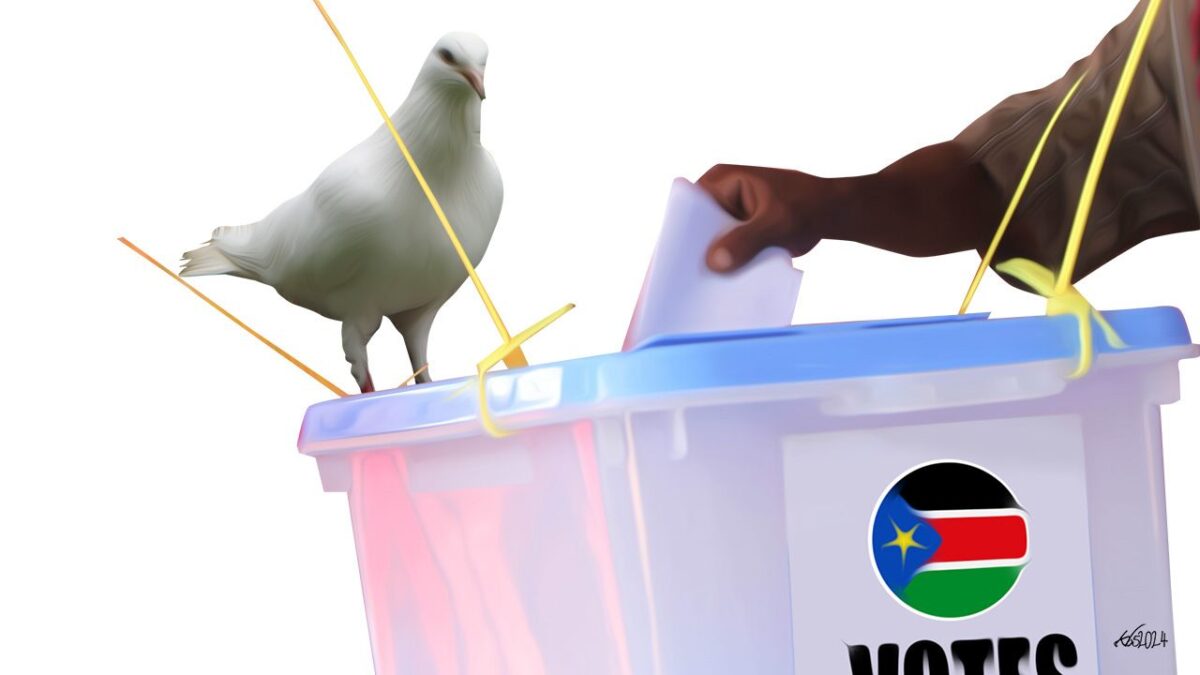
By Da-Ter Manyang Gatwech, Civil Society Activist| As South Sudan prepares for general elections scheduled for December 2026, one fundamental question continues to dominate national debate: should peace come before elections, or can elections themselves help bring peace?
This question lies at the heart of the country’s political future. For many South Sudanese citizens, civil society leaders, and observers, the concern is straightforward but profound: can a nation that is not fully at peace conduct free, fair, and credible elections? The answer may determine not only the success of the upcoming polls but also the long-term stability of the world’s youngest nation.
Peace is the foundation upon which all democratic processes rest. Elections require an environment in which citizens feel safe to express their views, gather publicly, and vote without fear of intimidation or violence.
In many parts of South Sudan today, however, insecurity, political tensions, and economic hardship continue to shape daily life. Intercommunal conflicts, the presence of armed civilians, and unresolved political rivalries still create uncertainty in several regions. These realities raise serious questions about whether the country is ready to organize elections that genuinely reflect the will of its people.
Another major concern relates to the strength and preparedness of electoral institutions. The National Elections Commission, responsible for organizing the polls, faces significant financial and logistical challenges.
Reports indicate that the Commission has so far received about 15 million dollars out of the estimated 250 million dollars required to conduct the nationwide electoral process. This large funding gap raises doubts about whether critical preparations can be completed in time.
Elections involve a complex range of activities, including voter registration, civic education campaigns, training of election officials, security arrangements, and the distribution of voting materials across a vast and often inaccessible country. Without adequate resources, implementing these essential tasks becomes extremely difficult.
South Sudan is still a young nation, and many of its democratic institutions remain under development. Decades of conflict disrupted political structures and limited opportunities for citizens and leaders to participate in competitive democratic elections.
Some observers suggest that many current political leaders have never personally participated in a competitive national election as voters or candidates. This limited experience can affect the understanding of key democratic principles, such as respect for electoral rules, acceptance of election results, and peaceful political competition.
Building a democratic culture takes time, practice, and commitment from both leaders and citizens.
Experiences from other African countries offer valuable lessons. Nations such as Kenya, Ghana, South Africa, and Nigeria have held multiple elections over several decades.
While these countries have faced their own political challenges, repeated electoral cycles have helped strengthen institutions, improve electoral management systems, and build public confidence in democratic processes.
Such institutional maturity develops gradually through consistent practice, reforms, and respect for democratic norms.
South Sudan’s current political environment remains fragile. Although the Revitalized Agreement on the Resolution of the Conflict in South Sudan ended large-scale civil war, several critical provisions of the peace agreement remain incomplete.
Key reforms such as security sector reform unification of armed forces, constitutional development and transitional justice and reconciliation have progressed slowly.
Holding elections before these reforms are fully implemented could risk exacerbating tensions rather than strengthening democracy.
Peace is not simply the absence of armed conflict. True peace includes reconciliation between communities, trust between citizens and the state, and confidence that disputes can be resolved through peaceful means.
Many South Sudanese families have endured years of displacement, violence, and economic hardship. For these communities, healing and rebuilding trust are essential steps toward a stable and democratic future.
Elections conducted in an environment marked by fear, hunger, and mistrust may struggle to reflect the genuine voice of the people.
Economic conditions also influence the success of democratic processes. Across South Sudan, many citizens face rising food prices, unemployment, and limited access to essential services.
When people are struggling to meet basic needs, meaningful political participation becomes more difficult.
As the common saying goes: “It is difficult to think about democracy on an empty stomach.”
Improving livelihoods and ensuring access to food, healthcare, and education would create a stronger foundation for informed and active civic participation.
Civic education will also be crucial if elections are to be credible. Citizens need to understand their right to vote, how to register as voters, how to participate peacefully in the political process and why their vote matters
Political parties and candidates must also be trained to compete peacefully and respect the rule of law.
Without widespread civic education, misinformation, manipulation, and confusion could undermine the electoral process.
Perhaps the most critical condition for credible elections is security.
Polling stations must be safe for voters, election officials, and observers. Candidates must be able to campaign freely without harassment or intimidation. Security forces must act professionally and remain neutral in protecting all citizens.
If voters fear violence or intimidation, the legitimacy of election results will inevitably be questioned.
Peace First, Elections Second
For these reasons, many analysts argue that peace must come first. A stable and secure environment would create the necessary conditions for credible elections.
This includes full implementation of peace agreements, disarmament and security reform, stronger institutions and national reconciliation efforts
Once these foundations are in place, elections can serve as a powerful tool for democratic transition and long-term stability.
Some political leaders argue that elections themselves can help produce peace by allowing citizens to choose their leaders democratically.
This argument has merit—but only if the electoral environment is properly prepared.
History shows that poorly organized elections in fragile states can deepen divisions and sometimes trigger renewed conflict.
South Sudan now stands at a crucial political crossroads. The decision about how to balance peacebuilding and electoral timelines will shape the country’s future.
Ideally, both processes should move forward simultaneously. But if the choice must be made between rushing into elections or consolidating peace, peace should take priority.
Free, fair, and credible elections in South Sudan will only succeed if the foundations of peace are firmly established.
Only then can elections truly reflect the will of the people and contribute to building a stable and democratic South Sudan.
Until those conditions are met, rushing into elections without addressing these fundamental challenges may create more problems than solutions.
Disclaimer: The views and opinions expressed in this article are those of the author, Da-Ter Manyang Gatwech, and do not necessarily reflect the views or editorial position of the publisher or its affiliated institutions.