

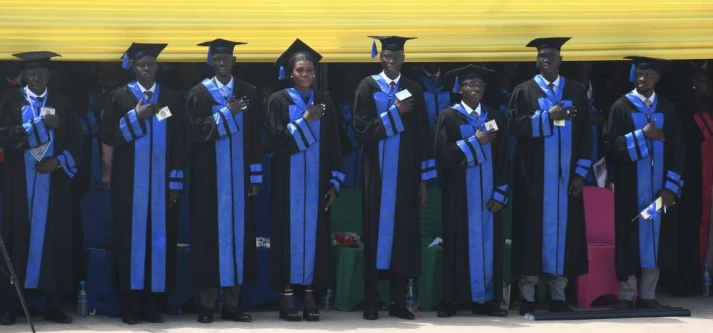
Graduates at Starfort International University have been urged to embrace self-reliance and entrepreneurship as South Sudan’s shrinking job market struggles to absorb a rapidly growing number of young job seekers.
The call comes against a backdrop of mounting economic hardship in a country that, despite being an oil producer, continues to face high unemployment, limited industrial growth, and heavy dependence on the public sector.
With one of the youngest populations in the region, thousands of graduates enter the labor market each year, competing for a narrow pool of formal jobs.
At the university’s graduation ceremony, more than 300 graduates were told that waiting for government employment is no longer a viable path. Leaders stressed that innovation, creativity, and private enterprise are increasingly becoming the only realistic options for many young people.
Speaking during the ceremony, Vice Chancellor Dr. James Osuru Mark described graduation as a significant milestone achieved through years of determination and sacrifice. He congratulated the graduates and recognized the support of lecturers, parents, and guardians in helping them reach this stage.
However, he cautioned that the real challenge begins after graduation.
“Education does not end here,” Dr. Osuru said. “It begins with how you apply your knowledge to solve real problems in society.”
He emphasized that South Sudan’s public sector—long seen as the primary employer—can only absorb a small fraction of graduates. As a result, he urged students to shift their mindset toward entrepreneurship, innovation, and skills development.
“Our economy needs creators, not just job seekers,” he added.
Dr. Osuru pointed to former students who have started small businesses in sectors such as agriculture, retail, and services, encouraging the new graduates to take similar initiatives despite the difficult environment.
South Sudan’s economy remains heavily reliant on oil revenues, yet fluctuations in global prices, combined with internal challenges, have limited broader economic expansion. This has left few opportunities in manufacturing, technology, and other sectors that typically generate employment in developing economies.
Chancellor Dr. Kenneth Muruma Wayne echoed the Vice Chancellor’s remarks, calling for what he described as a “mental revolution” among young people.
“We must move from theory to practice,” he said. “Education should empower you to create solutions, not just seek certificates.”
Dr. Muruma drew comparisons with countries like Singapore, noting that national success is driven more by innovation, discipline, and mindset than by natural resources.
“We have resources, but without the right mindset, they will not transform our economy,” he said.
He challenged graduates to overcome fear and self-doubt, and to take bold steps in building businesses and contributing to national development.
Also addressing the gathering, Minister of Higher Education, Science and Technology, Madut Biar Yel, acknowledged the difficult economic realities facing graduates but emphasized the critical role of educated citizens in shaping the country’s future.
“You are the drivers of change,” he said. “South Sudan needs skilled and committed young people to tackle its challenges.”
The minister encouraged graduates to pursue further education while also applying their knowledge to real-world problems, particularly in sectors such as agriculture, infrastructure, and technology.
Across the ceremony, speakers repeatedly highlighted the urgent need to expand the private sector and reduce reliance on government employment. They stressed that without entrepreneurship and innovation, the gap between graduates and available jobs will continue to widen.
For many of the graduates, the message was clear: in a country where opportunities remain limited despite its natural wealth, success will depend less on available jobs and more on the ability to create them.
The ceremony brought together government officials, university leaders, parents, and students—marking not only a celebration of academic achievement, but also a sobering call to action for a generation tasked with building its own future.